Difference between Hydroponics Aeroponics and Aquaponic
If you are looking for the best methods of soilless farming, then this article might help you a lot. Over the years, Soil degradation, excessive agrochemical use, and lesser land availability for farming have led to the development of this unique technology that allows a direct supply of nutrients in plants via some other medium instead of soil, encompassing aeroponics, hydroponics, and aquaponics.
Thousands of people all over the world have adopted this technology, not only to grow fresh veggies and herbs at home, but also for other commercial benefits. In addition, it is one of the most sustainable methods of farming and a tool to convert your empty urban spaces into an evergreen facade of healthy vegetables and fruits.
These two words hydroponics vs aeroponics are the new technology of agriculture which is now spreading all over the world. These technologies are very helpful in future as the degradation of soil is increasing and climate change makes the farmer disabled. To survive in future problems future technologies are a good saver. These both techniques are very good where there is less water availability for flood irrigation and open field irrigation is not possible due to lack of water. Having an indoor setup the crop is prevented from the insect pest and high and low temperatures. Also due to the ability to maintain the environmental conditions and light the growth phases of plants can be managed properly.
Let’s learn how these three methods differ from each other, what their pros and cons are, and which one is your cup of tea.
What is Hydroponics?
Hydroponics is a Latin word made up of two words “hydro” means water and “ponos” means working. In other words it is a water working mechanism without the involvement of soil. Then what should be the thing to hold the roots if soil is not used? Yes for holding the soil media like perlite, vermiculite, cocopeat etc are used. This helps in holding the roots of the plant and beneath the roots the nutrient solution flows which is absorbed by the plant. Hydroponics in other words is just like growing plants in a nutrient solution flow without use of soil, or open field.
There are different types of Hydroponics systems, like drip irrigation, deep water culture (DWC), nutrient film technique (NFT), or flood and drain (ebb and flow) methods. Now the choice of system depends upon your crop needs and the resources available to you
What is Aeroponics?
This method is also a hydroponic system method but it is totally different as in this method the nutrients solution is given to the plant in the form of mist, or the water is in gaseous form. Aeroponics is most suited in tuber and roots crops where the edible or consumable part or desirable parts are roots. In this system the roots of plants are hanging down and the nutrient solution in water is sprayed in various time intervals to the roots. This system does not need any kind of oxygen or aeration source as these roots are hanging in air all the time.
Aeroponics is a new technology , but in this new era it is successfully used in many major crops like tomatoes, strawberries and tubers. One of the main things that makes it useful is that it gives an upper hand to farmers that farmers can grow the crop at any time of the year without the interference of climatic conditions.
Technology used in Aeroponics:
Technology plays an important role in aeroponics as due to this technologies provide precise control of environmental factors, water conservation, space utilization, pest and disease control, all these contribute to improvisation in production of commerce. Talking about the technologies used in aeroponics are commonly sensors, dispenser related technology, and mechanical pumping systems.
Sensors: The most important technology in aeroponics is the sensors which are used to determine the environmental conditions eg. Temperature, humidity, nutrient levels, ph etc.. The data drawn from these sensors provides a difference between what is actually the condition and what is the optimum for the crop growing on. Then by adjusting the temperature and other factors enables the optimum growth.
What is Aquaponics?
Aquaponics means a combination of Aquaculture and hydroponics. Here, the fish waste is utilised in the form of essential nutrients to the plants, while plants purify the shared water for the fish, creating a natural, self-sustaining closed-loop system.
Don’t forget to add the artificial lighting system if your setup is indoors to support photosynthesis and monitoring tools like a thermometer, pH, and EC meter, ammonia and nitrate levels detector, and oxygen controller to maintain balance in the whole system.
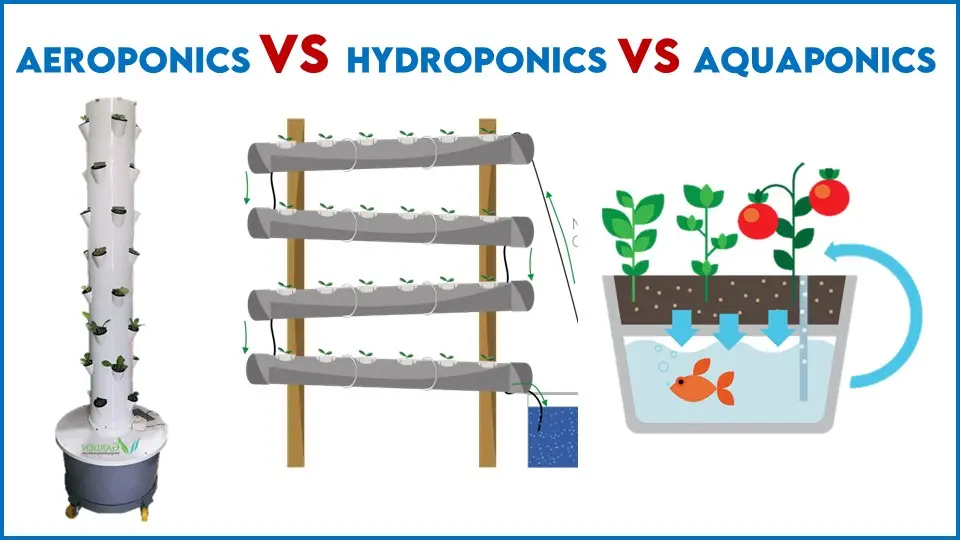
Difference between Aeroponics vs Hydroponics vs Aquaponics
Based on the key parameter, we can compare these systems as follows:
| Parameters | Aeroponics | Hydroponics | Aquaponics |
| Medium Used | Air (roots suspended and misted) | Nutrient-rich water or inert media | Fish waste-enriched water |
| Nutrient Source | Artificial nutrient solution | Artificial nutrient solution | Fish waste (natural fertilizer) |
| Water Usage | Lowest (up to 95% less than soil) | Low | Comparatively, a little higher. |
| Setup Cost | High (due to misting system and sensors) | Moderate to High | High (fish tank and hydroponic system) |
| Maintenance | High (nozzle clogging, misting system). | Moderate | High (fish health, water quality, balance). |
| Plant Growth Rate | Fastest (due to high oxygenation) | Fast | Moderate to Fast |
| Organic Certification | Not usually (uses synthetic nutrients) | Not usually (unless organic nutrients are used) | Possible (natural ecosystem-based) |
| Technical Knowledge | High | Moderate | High (aquaculture along with hydroponics) |
| Scalability | High (urban, vertical farming). | Very High (from home setups to commercial). | Moderate to High (space for fish needed). |
| Pest/Disease Risk | Low (no soil) | Low (controlled system) | Low (but fish diseases possible) |
| Sustainability | High | Moderate to High | Very High (symbiotic and organic). |
Which one is best for you?
Among these three types of soilless cultivation methods, you can choose the one that fulfills your crop demands, aligns with your values, and can be handled within your expertise.
If you are just a beginner to soilless cultivation, I suggest you adopt a small hydroponics system first, it is the easiest of all, shows better results, requires less training, and can be easily scaled up.
If you have enough experience, then you can go for aeroponics, which is a little more complex than the hydroponics system, but due to its higher nutrient absorption rate and misting, it offers quick plant growth and minimum water consumption.
The setup cost and Technical knowledge needed is an Aquaponics system is much higher than the other systems. But if you are up for a challenge, then you should definitely go for it. It provides a holistic and sustainable approach towards farming. And when you start seeing the chances of success in the system, you can also apply for organic certification, which could award you a higher price for your produce.
It is difficult to avoid diseases or system failures in any of these systems. The key to saving your produce is staying vigilant all the time and monitoring your produce regularly.
Conclusion.
Technological advances have led to many interesting discoveries in agriculture, yet the adoption of a sustainable and economically beneficial approach should be our first priority. Soilless farming has led to many successful stories in the past, making it an economically reliable option for all. Yet working with any of these methods needs training and adequate knowledge. We hope this article has helped you differentiate between aeroponics, hydroponics, and aquaponics and shown you the way to choose the best for yourself.
Latest Post
- Difference between Hydroponics Aeroponics and Aquaponic
- Bamboo Hydroponics System: Cutting Edge with Sustainability
- Can you Grow Roses Hydroponically: Hydroponic Rose
- Hydroponic Corn Farming : Hydroponic corn fodder?
Join Our Hydroponics Growers Group!
Connect with fellow hydroponics enthusiasts, share your ideas, ask questions, and grow together as a community.
👉 Join WhatsApp Group